
Cosmos is smiling… literally!
Hubble has spotted this smiling face in space.
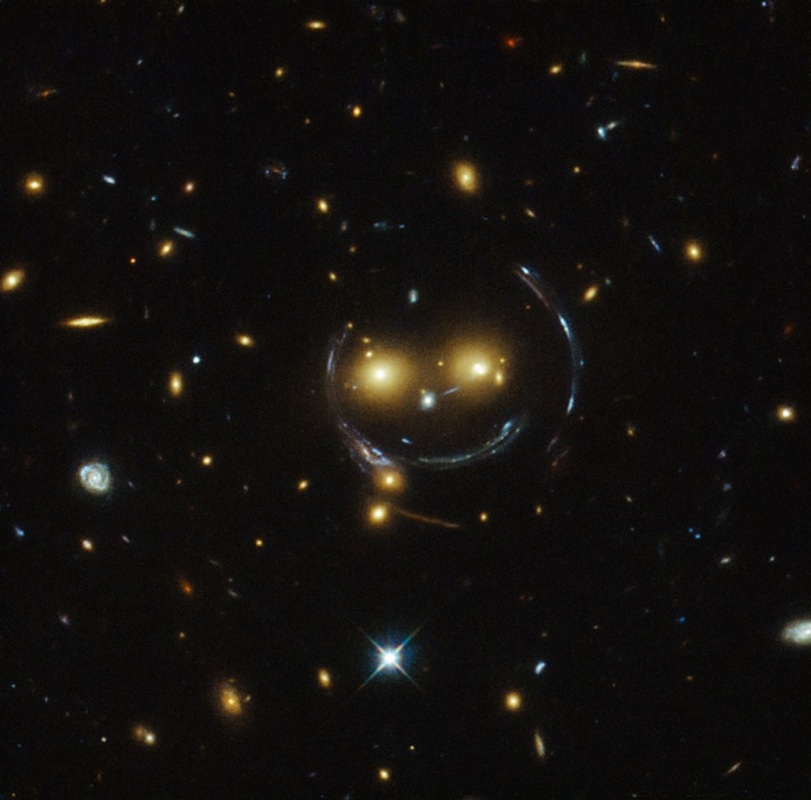
In the center of the image, taken by the NASA/ESA Hubble Space Telescope, is the galaxy cluster SDSS J1038+4849—and it appears to be smiling.
Images from space have captured many smiles from the surrounding galaxies, but it’s quite rare for one of them to smile back at us.
This adorable image—in which the galaxy cluster SDSS J1038+4849 appears to be smiling at the camera—is courtesy of the Hubble Space Telescope.
Our tendency to see faces in inanimate objects is due to a neurological phenomenon called pareidolia. The cause isn’t entirely clear, but it’s likely an evolutionary quirk: Humans have evolved to be really good at recognizing other people’s faces, even when they’re strangers or the lighting isn’t great. The reason could be that our brains get a little ahead of themselves and find pseudo-features that we know don’t exist, leading us to have the unsettling yet amusing sensation that our receptors are open.
In this case, the cosmic “face” is caused by a well-ordered galactic phenomenon called gravitational lensing. Large clusters of galaxies sometimes produce such a strong gravitational pull that it warps time and space around them. This can be significant for scientists on Earth because the warping can act as a natural “lens” and magnify distant objects behind the clusters, making them more visible to space telescopes. However, we must not forget that magnification distorts objects.
The ring that forms the “face” is called an Einstein Ring, and it is produced by a very specific view of such a distorted galaxy cluster. Another feature of the distortion is an asymmetrical smile.
Inside the ring, two bright galaxies are perfectly positioned as eyes, completing the illusion.
Source: Washington Post