
What do Roberto Carlos, Tiger Woods, and …Michalis Rakintzis have in common?!
They’ve all built their careers on …flats! And while the latter sings about a “baby” flat, the first two appear at the top of the list of the richest athletes, thanks to their ability to influence the ball’s trajectory (in soccer and golf, respectively) by striking it in a distinctive way on the top or bottom. If you think about it, the spin plays a primary role in all ball sports, whether it’s billiards, where it allows technically skilled players to hit a ball, passing around the one blocking them, or in basketball, where a long pass with the right spin can reach its destination by lifting the ball over the defender and landing just in time in the hands of the advancing attacker on the fast break.
Roberto Carlos
In the following clip, notice the ball’s trajectory after Roberto Carlos’s thunderous shots!
The Magnus effect
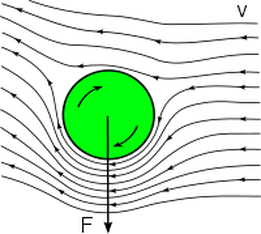
What exactly is happening that causes the ball to gradually veer off course? We must remember that athletes strike the ball in such a way that the point of contact (of the club, racket, or shoe) with the ball and the direction of the strike do not pass through its imaginary center? As expected, after the strike, the ball begins to spin around its center while simultaneously moving forward. The ball’s rotation triggers the Magnus effect, named after the German physicist Heinrich Magnus, who described it in detail in the mid-19th century, nearly two centuries after Newton’s initial observations. So, as the ball spins, the airflow around it takes the form of a vortex, parallel to the direction in which the ball is spinning. The ball’s path is deflected to the side because the air following the ball’s surface within this vortex separates more slowly on the side of the ball moving in the same direction as the vortex, and thus it “manages” to push the ball, since the air on the other side separates earlier, creating a pressure difference.
Similarly, if we strike the ball on its lower part (what in billiards or golf is called a “back” or “down” spin), the ball rises much more quickly. This also alters the symmetry of the ball’s trajectory: according to the laws of physics and ignoring air resistance for the moment, the ball would reach the highest point of its trajectory (the so-called “zenith”) exactly at the midpoint of its flight path—but in this specific example, the ball is also lifted by the Magnus effect.