
There are only the giants of the mind!
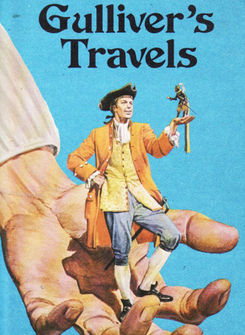
In 1726, the Irish author Jonathan Swift first published his work *Gulliver’s Travels*, which is considered a classic of English literature. In this fantasy novel, the protagonist Lemuel Gulliver, on his journey to unknown worlds, discovers the kingdom of Lilliput, where everything resembled that of our own world, but with one key difference: people, animals, trees, and objects were about 12 times smaller! The inhabitants of Lilliput were about 15 centimeters tall and had a corresponding physique. On another journey, the protagonist visited Brobdingnag, the land of giants, whose inhabitants were about 12 times taller than the people of our own world. As Swift writes in this work, daily life in these two imaginary kingdoms bore a striking resemblance to our own. Swift may have intended this work to satirize the writers of his time, or perhaps he wanted to denounce the corruption inherent in human nature; he may even have been the father of Jules Verne’s science fiction novels. In this text, however, the discussion will turn to the disagreements that Uncle Galileo had many years ago, and we will see that it is impossible for humanoid beings to exist at the size described in Swift’s work.
It is relatively easy to understand that the strength of a rope is proportional to its thickness, that is, proportional to the area of its cross-section. Generally, the concept of area refers to two dimensions; for example, the area of a square is side times side, that is, length raised to the second power (L²). What applies to a taut rope also applies to the compression of beams or columns. In other words, the thicker a column is, the more it can withstand.
The human body and those of other animals are known to be supported by the skeleton and perform hundreds of movements thanks to the muscles. In other words, it is made up of a system of “posts” and “cables” which, as mentioned above, their strength is proportional to their thickness. On the other hand, because on a macroscopic level we are not hollow, our flesh, which sits atop our skeleton, together with our skeleton, constitutes our weight. Thus, the weight of our body that is supported is proportional to the amount of flesh and bone, and therefore proportional to our volume. Regarding the concept of volume, it is worth noting here that it is proportional to the cube of a dimension (L³). For example, to find the volume of a cube, we must multiply its three sides (side × side × side).
Therefore, the giants of Brobdingnag, who were 12 times taller than the normal-sized Gulliver, would have to have each dimension 12 times larger. Consequently, a giant’s bones would be 12 times thicker and thus (according to what we mentioned above regarding surface area) 12 x 12 = 144 times more durable. However, the giant’s weight, which is proportional to his volume, would be 12 x 12 x 12 = 1,728 times greater than the weight of a normal human! From this, we understand that the strength of the skeletal structure is not sufficient to support him. The ratio of the giant’s material strength to his weight is 12 times smaller than the corresponding ratio for a normal human. To make this perhaps even clearer, the giant would have the same difficulty as a person carrying 11 other people on his back!
Galileo described this issue with precision, proving the zero probability of the existence of Brobdingnag or other humanoid giants: ‘… if one wishes to maintain the same proportional dimensions of the body parts in large giants as in humans, they must use a harder and more durable material for the construction of their bones or accept a significant reduction in the giants’ strength compared to that of humans. Because, if their body height increases too much, it will collapse and be crushed by its own weight…’
So you can safely enjoy fairy tales and stories about humanoid giants, since they have never walked on this Earth and never will! With the seal of science!
Zaras Giannis
Physicist
Bibliography
– Serway – Physics for Scientists & Engineers: Volume 1
– Wikipedia