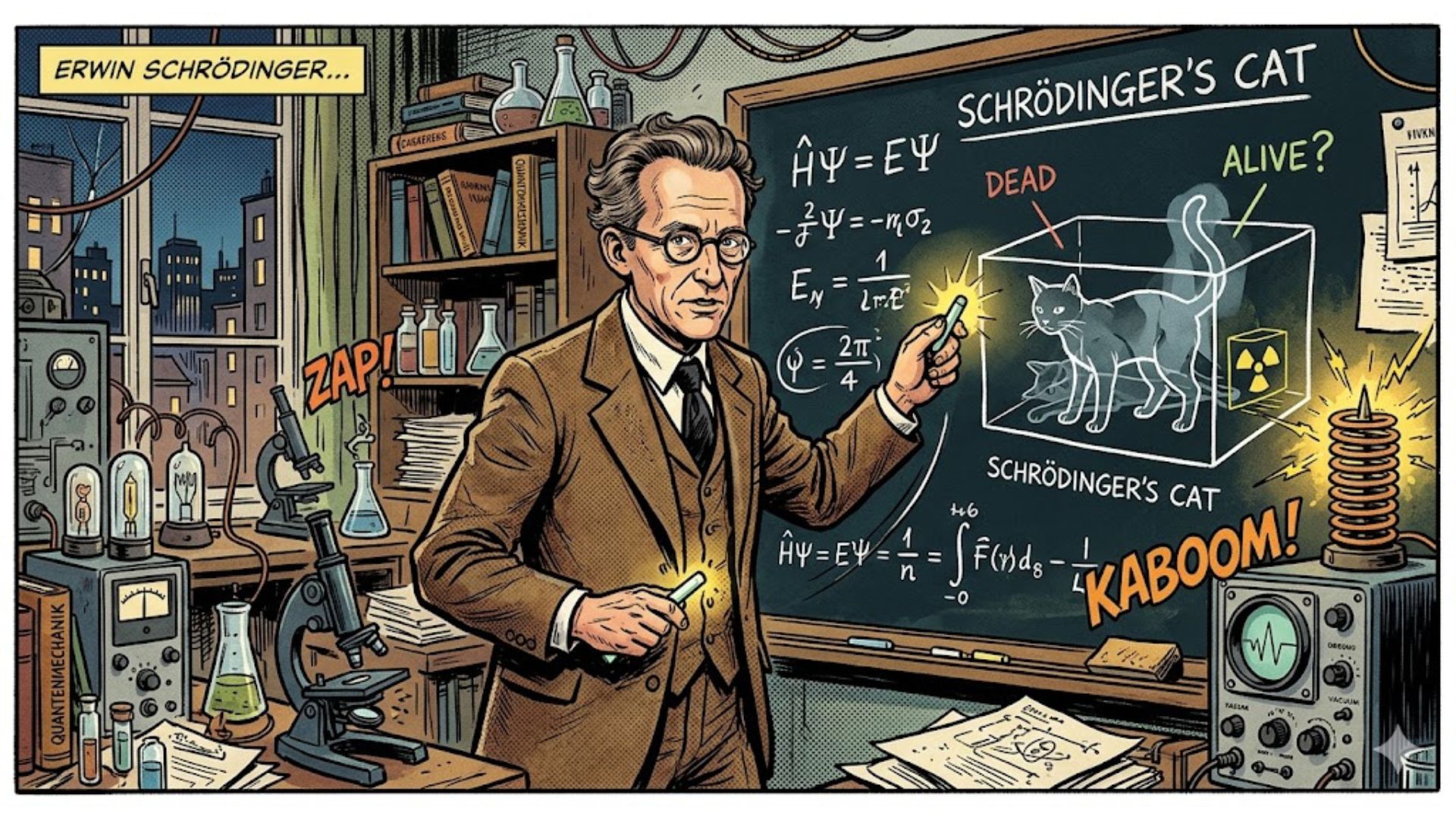
Erwin Schrödinger (1877–1961). He was born in Vienna to an Austrian father and an English mother. A cultured and artistic man, he had a talent for presenting his views in a charming manner. He taught in Zurich, where he formulated his famous equation, as well as in Berlin, Oxford, and Dublin. At the end of his life, he returned to Vienna. He shared the Nobel Prize in Physics with R.A.M. Dirac in 1933.
Schrödinger’s cat paradox is one of the most famous thought experiments in the history of science. It was proposed by physicist Erwin Schrödinger in 1935, not to show that cats have… magical properties, but to highlight a huge problem in the interpretation of Quantum Mechanics (the physics of the microcosm).
The paradox tells us the following:
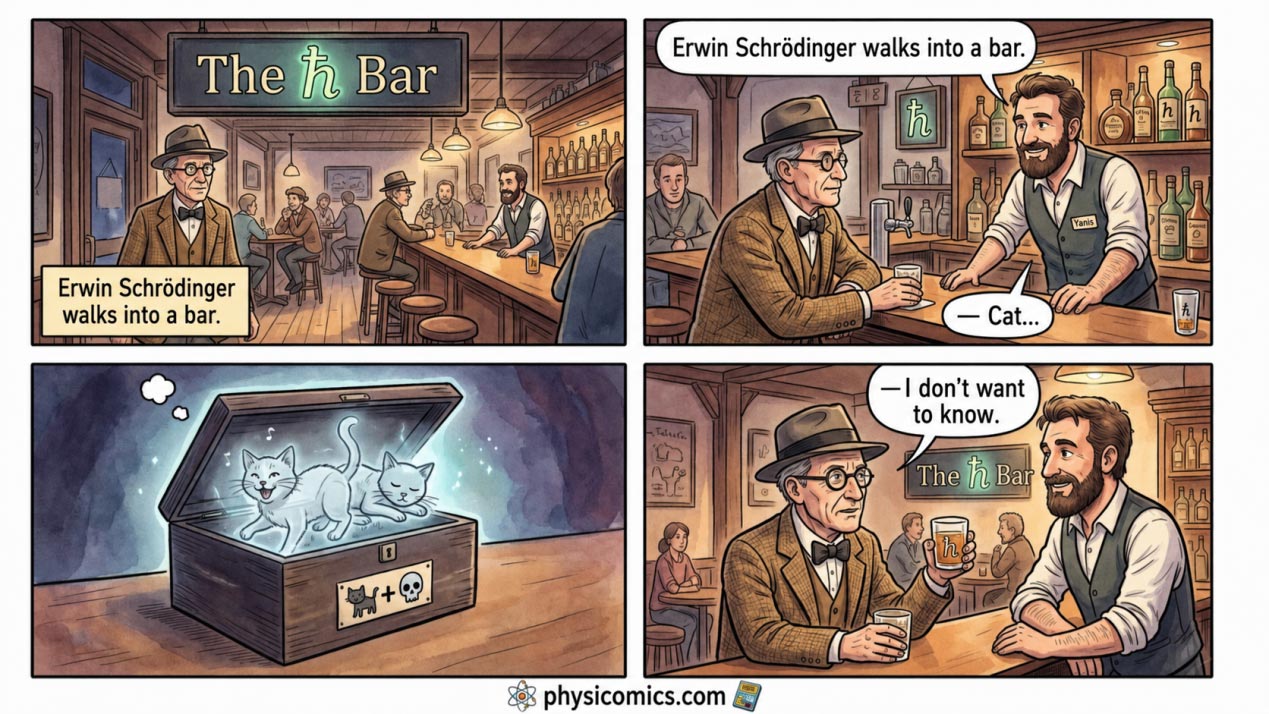
Imagine a cat locked inside an opaque box. Inside the box is a mechanism containing a tiny amount of radioactive material. There is a 50% chance that within an hour, an atom will decay, and a 50% chance that it will not. If the atom decays, a detector records it, releases a poisonous gas, and the cat dies. If it does not decay, the cat lives.
According to the rules of quantum physics, as long as the box is closed and no one sees what is happening inside, the radioactive atom is in a state called superposition. That is, it is both decayed and undecayed at the same time.
Since the cat’s fate is directly linked to the atom, this means that until we open the box, the cat is both alive and dead at the same time!
Why is this paradoxical?
Το πρόβλημα που ήθελε να τονίσει ο Schrödinger είναι η σύγκρουση ανάμεσα στον μικρόκοσμο και τον μακρόκοσμο:
- Στον μικρόκοσμο (κβαντικό επίπεδο): Τα σωματίδια μπορούν όντως να βρίσκονται σε πολλές καταστάσεις ταυτόχρονα (υπέρθεση).
- Στον μακρόκοσμο (την καθημερινή μας πραγματικότητα): Κάτι τέτοιο είναι αδύνατο. Μια γάτα δεν μπορεί να είναι “μισοζώντανη-μισονεκρή”.
The problem Schrödinger wanted to highlight is the conflict between the microcosm and the macrocosm:
- In the microcosm (quantum level): Particles can indeed exist in multiple states simultaneously (superposition).
- In the macroscopic world (our everyday reality): Such a thing is impossible. A cat cannot be “half-alive, half-dead.”
The paradox focuses on the process of measurement or observation.
According to the classical interpretation of quantum physics (the Copenhagen Interpretation), the mere act of opening the box and looking inside “forces” nature to choose one of the two states. This is called wave function collapse.
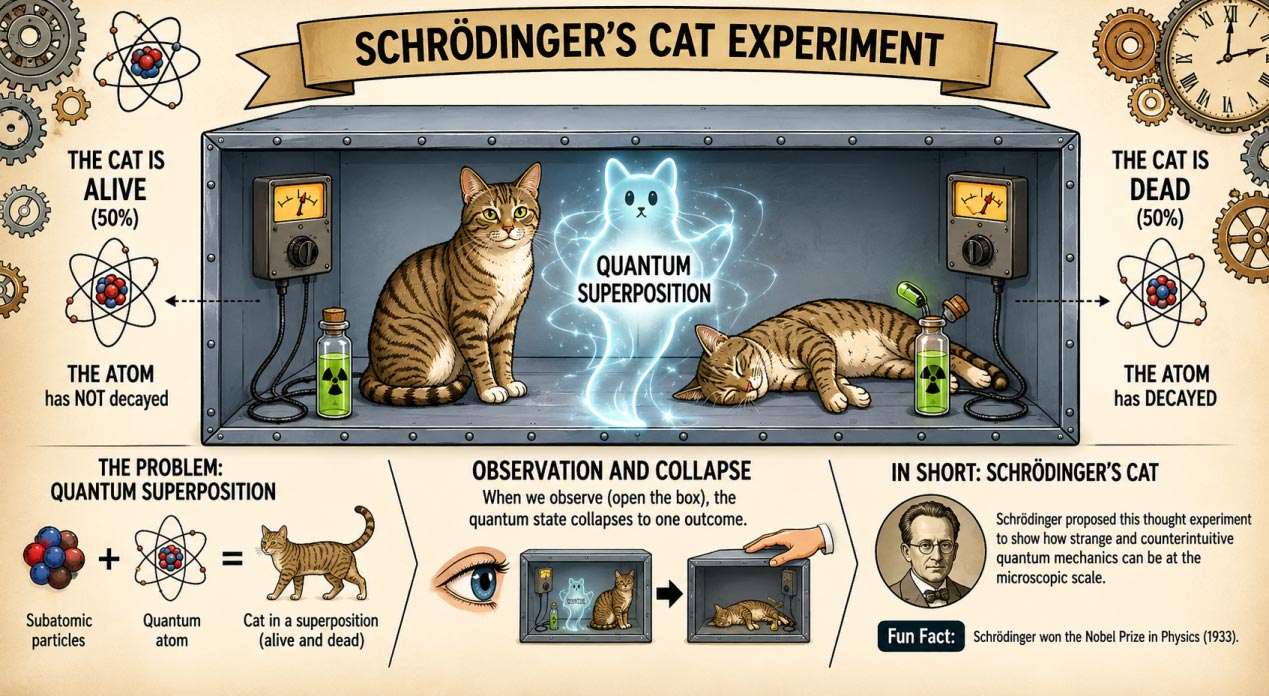
Schrödinger, then, used the cat as a hyperbolic example to say: “Look how absurd it sounds when we apply the rules of subatomic particles to the real world. Where exactly does quantum uncertainty end and clear reality begin?”
Fun Fact: Schrödinger himself loved animals and hated quantum theory (even though he helped build it). With this experiment, he wanted to show that the theory had gaps, but in the end, his example became its most popular symbol!