

Doppler Effect
The Doppler effect is the observed change in the frequency and wavelength of a wave as perceived by an observer moving relative to the wave source. It was named in honor of the Austrian physicist Christian Doppler, who proposed it in 1842. The effect is often observed when a vehicle with a siren (e.g., an ambulance) or making noise (e.g., engines). Specifically, the frequency of the sound increases as the vehicle approaches the observer, while it decreases as it moves away from the observer.
For waves such as sound waves, which propagate through a material medium, the velocity of both the observer and the source must be determined relative to the medium of propagation. The final Doppler effect can therefore result from the motion of the observer, the motion of the source, and the motion of the medium of propagation. For waves that do not require a material medium for their propagation, such as electromagnetic (light) or gravitational waves in special relativity, only the relative velocity of the observer and the source plays a role.
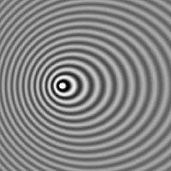
A wave source moving to the left. The frequency is higher on the left and lower on the right. Correspondingly, the wavelength is shorter on the left and longer on the right.
General form of the phenomenon
For waves propagating through a material medium (sound, ultrasonic, pressure waves, etc.), the relationship between the observed frequency (ν’) and the emitted (actual) frequency (ν) is given by the equation:
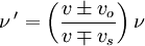
where
u is the wave propagation velocity (e.g., 340 m/s for sound in air),
uo is the observer’s velocity relative to the medium,
and us is the source’s velocity (emitting the wave) relative to the medium.
The signs of the velocities follow this convention: a positive value means the observer is moving toward the source, while a negative value means moving away from the source. For the source’s velocity, the opposite convention applies.
A good mnemonic rule is as follows: for both the observer and the source, “approaching” tends to increase the frequency, while “moving away” tends to decrease the frequency, with the directions of motion always being relative to the medium of propagation. It is important to understand that when, for example, the direction of the observer’s motion is “toward” the source, this does not necessarily mean that the observer is approaching it—the source may be moving away at a greater speed. However, to determine the correct sign, it is sufficient to know the “tendency” of the source or the observer to approach or move away, regardless of the final outcome. The final frequency value will result from the relative “strength” of the numerator and denominator in the above formula, and may be smaller, larger, or even equal to the actual frequency, depending on which factor prevails.