

The only program for detecting dangerous asteroids in the southern hemisphere has been shut down.
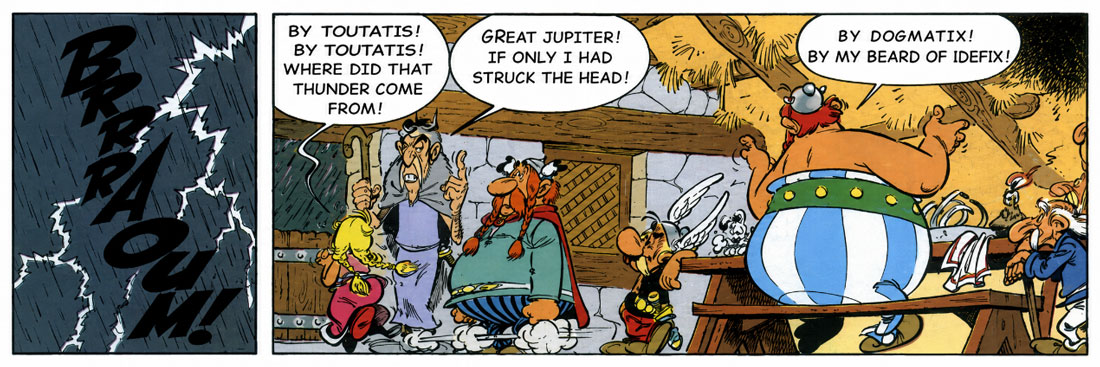
The only thing that frightened the Gauls in *Asterix* was the sky falling on their heads!
But compared to Asterix’s time—50 B.C.—our civilization has made enormous strides, and modern humans have likely stopped fearing that the sky will fall on their heads. This explains why programs to detect asteroids dangerous to Earth are gradually being discontinued, despite the concerns expressed by various scientists…
Another step in this direction is… the suspension of the only program for the early detection of dangerous asteroids in the southern hemisphere. The program, thanks to which Comet Siding Spring—which on Sunday, February 18, 2015, passed within a few hundred kilometers of the planet Mars—was detected, was halted a few months ago when NASA cut off its funding.
The Siding Spring Survey was conducted at the observatory of the same name in Australia. With its discontinuation, the chances of detecting an asteroid from the southern hemisphere that is set to pass at a dangerously close distance from Earth are drastically reduced. “Such a space rock could very well be approaching us right now, without us knowing it,” notes Bradley Tucker, an astronomer at the Australian National University and the University of Berkeley, in the Australian edition of The Guardian.
Celestial bodies with a diameter of at least 150 meters, which are expected to approach our planet at a distance of less than 7.5 million kilometers, are classified as potentially hazardous asteroids. To date, 1,508 such rocks have been identified in space, while one of the most well-known confirmed asteroid impacts on Earth occurred about 65 million years ago, causing such widespread destruction that it contributed to or was the cause of the extinction of the dinosaurs.
By the time it was suspended, the Siding Spring Survey had discovered 15 potentially hazardous celestial bodies. When NASA announced it would suspend funding, the Australian National University sought resources from the local government or even private donors, but to no avail.
The corresponding program covering the northern hemisphere of the sky is called the Catalina Sky Survey and continues to operate using two telescopes in Arizona, USA. With the “curtain falling” on the Siding Spring Survey, however, there is no longer any comparable systematic effort in the southern hemisphere. All that remains now is for amateur astronomers to observe the sky with sufficiently good telescopes.
According to Tucker, governments view these endeavors more as purely academic projects—even though they have the same preventive importance as programs that track and monitor hurricanes.
But perhaps Tucker is wrong. Maybe “our governments” have found another, zero-cost way to predict whether an asteroid will fall on our heads.
Source: theguardian.com