
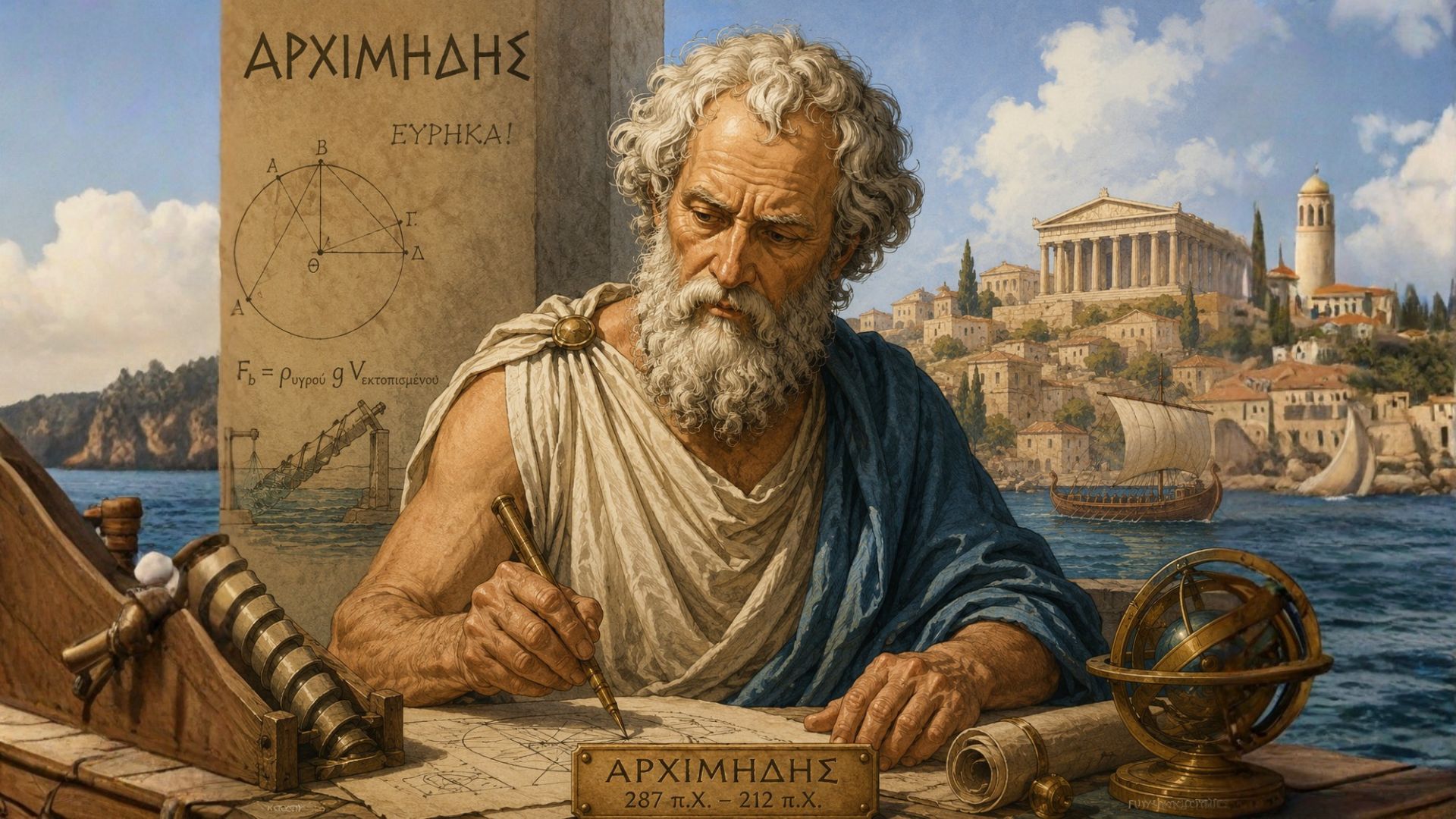
Archimedes and the “Eureka!
King Hiero II of Syracuse gave a goldsmith pure gold to make a magnificent crown.
When the crown was finished, the king began to suspect that the goldsmith had stolen some of the gold and replaced it with cheaper silver. The problem was difficult. The crown weighed exactly as it should, and they didn’t want to melt it down to check. So the king asked Archimedes for help.
Archimedes reasoned that if the crown contained silver, it would have a different volume than a piece of pure gold of the same weight, because gold is denser.
He therefore had to measure the density of the crown and compare it to the density of pure gold. p=m/v. While the mass of the crown was very easy to measure with a scale, its volume was impossible to measure because the crown has an irregular shape. For days, Archimedes thought about it without finding a solution. One day, as he stepped into a bathtub filled with water, he noticed that the more he sank, the more water spilled out. Then he realized something important: An object displaces a volume of water equal to its own volume.
And that’s when the idea struck him! It is said that he was so excited by the discovery that he ran out into the streets shouting:
“Eureka! Eureka!”
Probably the first “viral science moment” in history.
Archimedes compared how much water the crown displaced with how much water pure gold of the same weight displaced. The crown displaced more water, so it had a greater volume. This meant it wasn’t made of pure gold.
The goldsmith had indeed stolen gold!
“Do not disturb my circles”
In 212 B.C., during the Roman siege of Syracuse, Archimedes was absorbed in a geometric problem. He had drawn circles and shapes in the sand and was studying his calculations.
When the Romans stormed the city, a soldier approached Archimedes and asked him to follow him to the Roman general Marcus Claudius Marcellus.
Archimedes, so engrossed in his thoughts, is said to have replied:
“Do not disturb my circles”
meaning:
“Do not ruin my figures” or “Let me finish my problem.”
The soldier became enraged or took it as a sign of contempt and killed him on the spot.
Is the phrase true?
We do not know if it was said exactly that way. The story is recorded by later writers, such as Plutarch and Valerius Maximus, several years after Archimedes’ death.
The authentic Latin version is often given as:
Noli turbare circulos meos
(“Do not disturb my circles”)
The phrase symbolizes:
absolute devotion to knowledge, the power of science and thought,
but also the conflict between war and the spirit.
That is why it is used figuratively today when someone does not want to be interrupted while seriously engaged in something important.